Jane Salihu
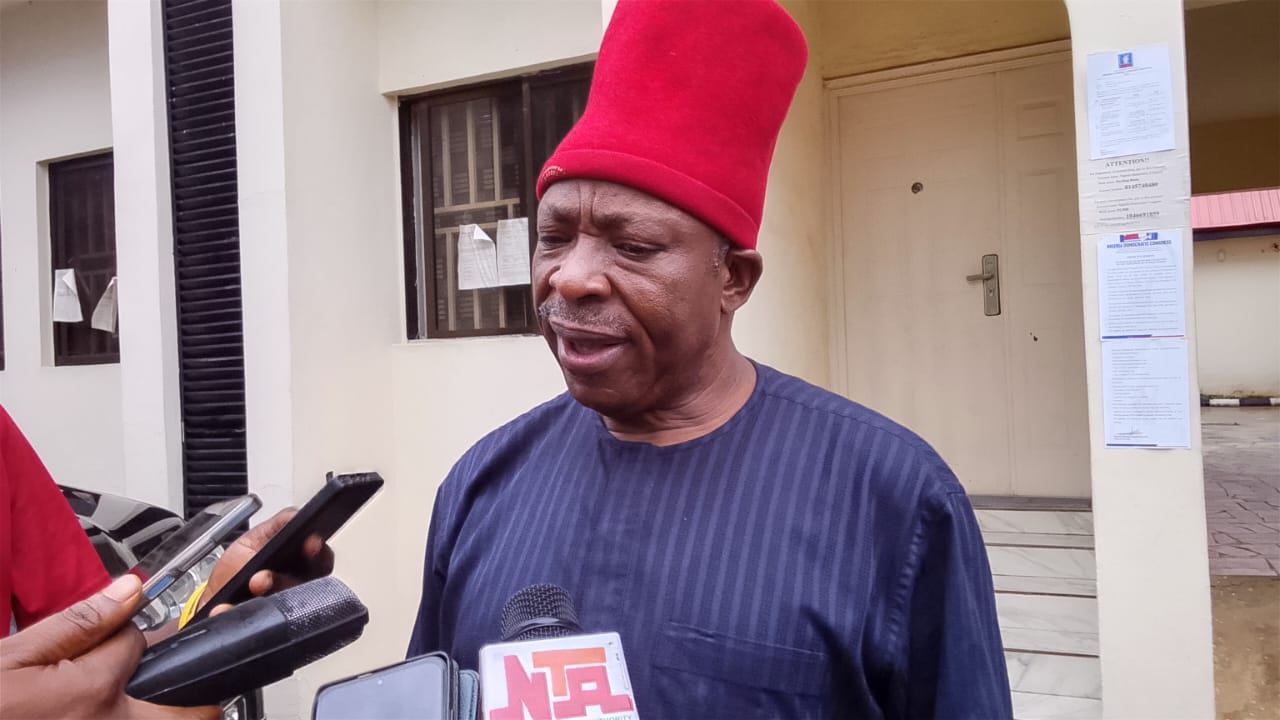
A federal lawmaker and chieftain of the Nigeria Democratic Congress (NDC), Senator Victor Umeh, representing Anambra Central Senatorial District in the 10th Senate, has warned political parties against relying solely on the recent Federal High Court judgment extending the deadline for submission of party membership registers, saying parties must still comply with the timetable released by the Independent National Electoral Commission (INEC).
Umeh spoke with journalists shortly before the inauguration of the screening committee of the Nigeria Democratic Congress (NDC) at the party secretariat in Abuja.
The senator said although the court judgment was well-considered, it remained a High Court decision that could still be overturned on appeal, making it risky for political parties to relax their preparations.
“For the fact that it is the judgment of the first court, the High Court, it will be very risky for any party to begin to relax and say the deadline has been extended,” he said.
“If INEC appeals and the judgment is overturned, parties that delayed their processes will be like fish out of water. So every sensible party should conclude its processes within the present INEC timetable.”
Umeh said the NDC would conclude its governorship, National Assembly and other primaries on May 28, while the party’s presidential primary would hold between May 29 and 30.
Speaking on the growing strength of the NDC ahead of the 2027 general elections, Umeh said the opposition party was becoming a major political force following the return of former presidential candidate Peter Obi and former Kano State governor Rabiu Musa Kwankwaso to the party.
According to him, the influx of politicians and aspirants into the NDC showed that Nigerians were beginning to rally around the party as a credible alternative ahead of the elections.
“NDC will offer Nigeria the best candidates for this election. The signs are already there,” he said.
Umeh also faulted INEC’s electoral timetable, arguing that the commission unnecessarily compressed political activities and placed parties under avoidable pressure.
According to him, the Electoral Act allows presidential elections to be conducted as late as 30 days before the expiration of the current administration’s tenure, making the January 16, 2027 date fixed by INEC unnecessarily early.
“INEC could still validly conduct the presidential election by April 2027. So why bring it down to January 16, almost five months earlier? They have boxed all the parties into unnecessary pressure,” he said.
The senator said newer parties like the NDC required more time to organise congresses, conventions and primaries, especially amid the increasing number of defectors and aspirants joining the party across the country.
He described the Federal High Court judgment extending the timeline as an opportunity for INEC to review how it issues regulations and guidelines to political parties.
On developments within the National Assembly, Umeh criticised what he described as the growing trend of outgoing governors taking over Senate tickets in their states after completing their tenure.
According to him, the development had denied many serving senators fair opportunities during party primaries and created unhealthy political rivalries within states.
“Nobody can stand against a sitting governor in a primary. A lot of senators have become victims,” he said.
The senator added that the National Assembly may have to consider reforms after the 2027 elections to address the issue and strengthen internal democracy within political parties.