Jane Salihu
The Federal Government has intensified its push for evidence-based reforms in the education sector, revealing that more than one million out-of-school children have been successfully enrolled back into classrooms within the last two years through targeted interventions.
Minister of Education, Dr. Tunji Alausa, disclosed this at the 2026 Annual Education Summit of the Education Correspondents Association of Nigeria (ECAN) in Abuja, where he challenged journalists to use official education data to demand greater accountability from education managers at the federal, state and local government levels.
Addressing participants at the summit, themed “Three Years of the Tinubu Administration: Assessing Reforms, Progress and Challenges in Nigeria’s Education Sector,” the minister said the administration’s interventions were being guided by credible statistics rather than assumptions.
According to him, while the return of over one million children to school represents a significant milestone, the government recognises that millions more remain outside the formal education system. To close that gap, he said the Ministry of Education is collaborating with the National Bureau of Statistics (NBS) on a nationwide household survey to establish the country’s actual out-of-school population and develop targeted solutions.

Alausa identified inadequate access to junior secondary education as one of the biggest structural challenges confronting the sector, noting that Nigeria currently has about 90,000 primary schools but only 16,000 junior secondary schools.
He explained that although approximately 25 million pupils are enrolled in primary schools, only about five million transition to junior secondary education, describing the disparity as a clear indication that access—not enrolment—is the country’s biggest education challenge.
The minister also unveiled the Federal Ministry of Education’s Digitalised Nigeria Education Management Information System (DNEMIS), describing it as a powerful accountability tool that provides real-time information on school enrolment, classroom availability, teacher distribution and infrastructure across the country.
He urged education correspondents to leverage the platform in tracking government performance and exposing gaps in service delivery.
“The data is there for everyone to use. It enables journalists to interrogate education outcomes, challenge policymakers where necessary and ensure public resources are effectively utilised,” he said.
Alausa further stated that preliminary findings from the 2024/2025 Annual School Census have already begun shaping policy decisions, reiterating that reforms under the current administration are anchored on verifiable evidence.
Beyond basic education, the minister highlighted progress in maintaining industrial harmony across tertiary institutions, expanding Technical and Vocational Education and Training (TVET), promoting Science, Technology, Engineering and Mathematics (STEM), accelerating digital transformation and improving the global competitiveness of Nigerian universities.
Also speaking, the Minister of State for Education, Prof. Suwaiba Ahmad, described the ongoing changes as a comprehensive transformation agenda designed to reposition the education sector for long-term growth.

She said the Nigerian Education Sector Renewal Initiative (NESRI) is spearheading reforms in teacher development, curriculum review, digital learning, STEM education, technical and vocational training, quality assurance and institutional governance.
Executive Secretary of the Universal Basic Education Commission (UBEC), Dr. Aisha Garba, reaffirmed the commission’s commitment to expanding access to quality basic education, stressing that every Nigerian child deserves the opportunity to learn irrespective of social or geographical background.
Earlier, ECAN Chairman, Mr. Chuks Ukwuatu, said the annual summit provided a platform for stakeholders to review the achievements, challenges and future direction of education reforms under the current administration.
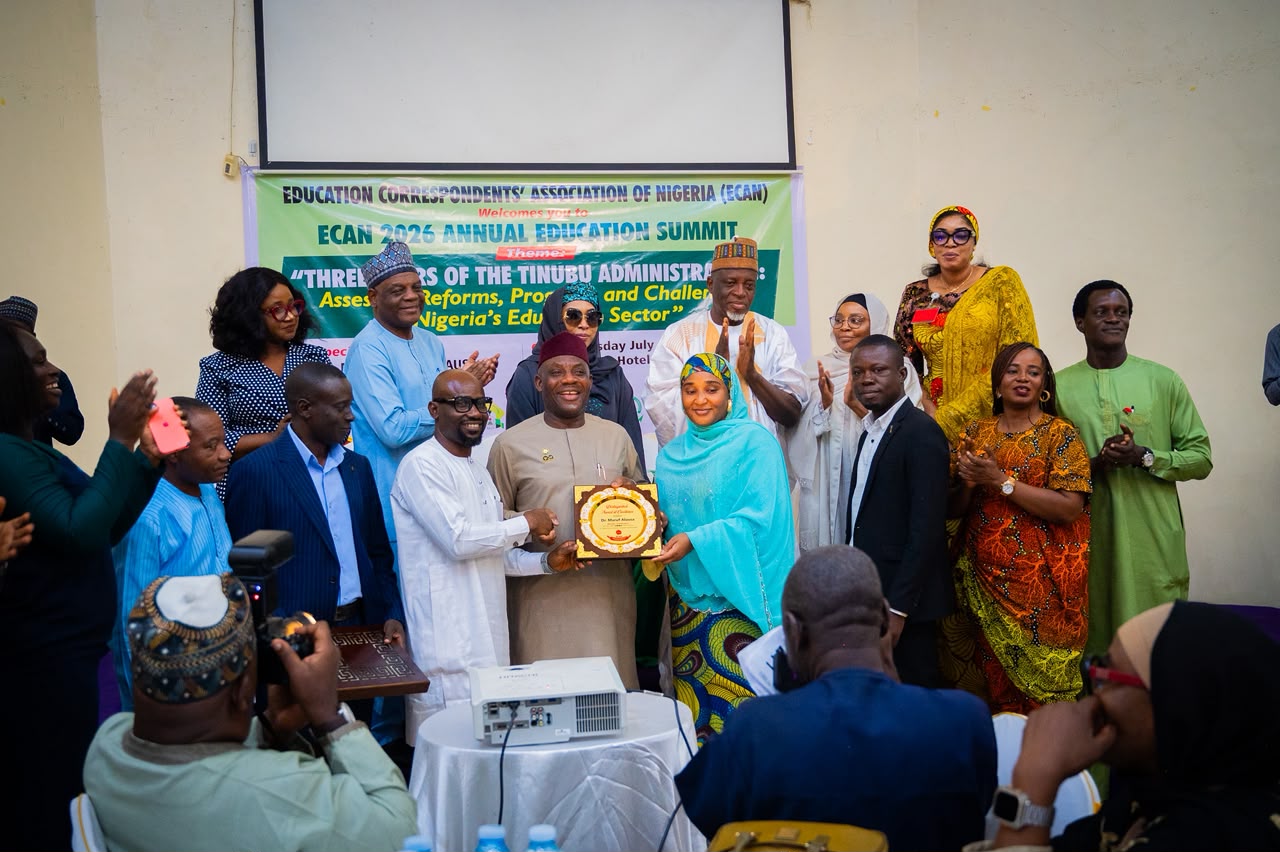
The event also featured the presentation of excellence awards to outstanding contributors to Nigeria’s education sector. Among those honoured were the Minister of Education, Dr. Tunji Alausa; Executive Secretary of the Tertiary Education Trust Fund (TETFund), Arc. Sonny Echono; JAMB Registrar, Prof. Ishaq Oloyede; Executive Secretary of the National Universities Commission (NUC), Prof. Abdullahi Ribadu; and NECO Registrar, Prof. Dantani Wushishi, alongside other education administrators recognised for advancing educational development in the country.