By Janet Salihu
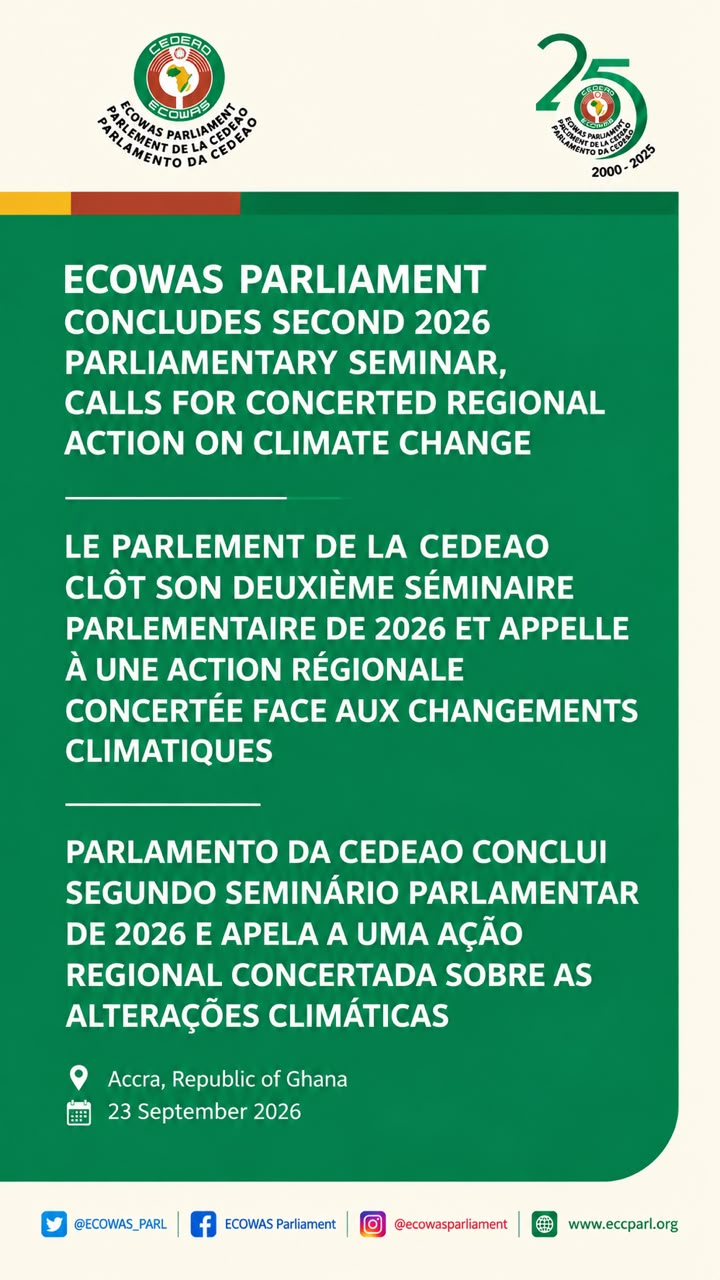
The ECOWAS Parliament has called for the establishment of a Regional Climate Resilience Fund and stronger early warning systems to help Member States and vulnerable communities confront worsening droughts, floods, coastal erosion and other climate-related threats across West Africa.
The demands were issued at the closing ceremony of the Parliament’s Second 2026 Parliamentary Seminar in Accra, Ghana, where lawmakers and stakeholders urged governments to move beyond deliberations and implement coordinated regional measures, including expanded agroforestry, accelerated adoption of renewable energy and stronger parliamentary oversight of climate commitments.
The three day seminar, held under the theme, “Climate Change as a Driver of Environmental Degradation, Population Displacement and Growing Insecurity in the ECOWAS Region,” brought together parliamentarians, experts and other stakeholders to examine the links between climate change, displacement, environmental degradation and regional security.
Declaring the seminar closed, Speaker of the ECOWAS Parliament, H.E. Hadja Mémounatou Ibrahima, said the worsening climate situation was placing mounting pressure on vulnerable populations across the region.
She cited intensifying droughts and floods, receding coastlines and other environmental pressures as challenges requiring coordinated regional responses rather than isolated national interventions.
“The time has come for action,” Ibrahima declared, urging Members of Parliament to return to their respective Member States with the lessons and recommendations from the seminar and advocate for their implementation.
Among the key recommendations from the deliberations was the establishment of a Regional Climate Resilience Fund to strengthen the capacity of Member States and vulnerable communities to respond to climate related shocks.
The parliamentarians also called for stronger early warning systems, expanded agroforestry practices and accelerated adoption of renewable energy as part of broader efforts to strengthen environmental resilience and reduce climate related vulnerabilities.
Ibrahima further called for inclusive climate policies, equitable access to climate finance and stronger parliamentary oversight of the implementation of Nationally Determined Contributions and other regional climate commitments.
She said political will, innovation and regional cooperation could help the region turn climate challenges into opportunities for resilience, sustainable development and greater regional stability.
The closing session featured a documentary highlighting the effects of climate change across different sectors, followed by country presentations from Côte d’Ivoire, Cabo Verde, The Gambia, Togo and Nigeria.
The country reports provided national perspectives on emerging climate threats and the measures being adopted to address them, while highlighting the need for stronger coordination among ECOWAS Member States.
The Speaker assured participants that the conclusions and recommendations of the seminar would be transmitted to the relevant authorities and subjected to follow up, stressing the Parliament’s role in advancing regional integration, climate resilience and collective security.
She formally declared the Second 2026 Parliamentary Seminar closed, calling for sustained regional cooperation towards a peaceful, resilient and prosperous West Africa in line with the aspirations of ECOWAS Vision 2050.
The seminar’s outcome placed climate change beyond the environmental agenda, highlighting its growing implications for population stability, livelihoods, development and peace and security across the ECOWAS region.