By Janet Salihu
ACCRA, Ghana: The changing climate in West Africa is increasingly becoming a question of survival, livelihoods and security, as environmental pressures push communities towards displacement while intensifying competition over land, water and other natural resources.
This emerging reality is at the heart of deliberations in Accra, Ghana, where members of the ECOWAS Parliament, regional institutions, governments, development partners and other stakeholders are examining the growing links between climate change, environmental degradation, population displacement and insecurity.
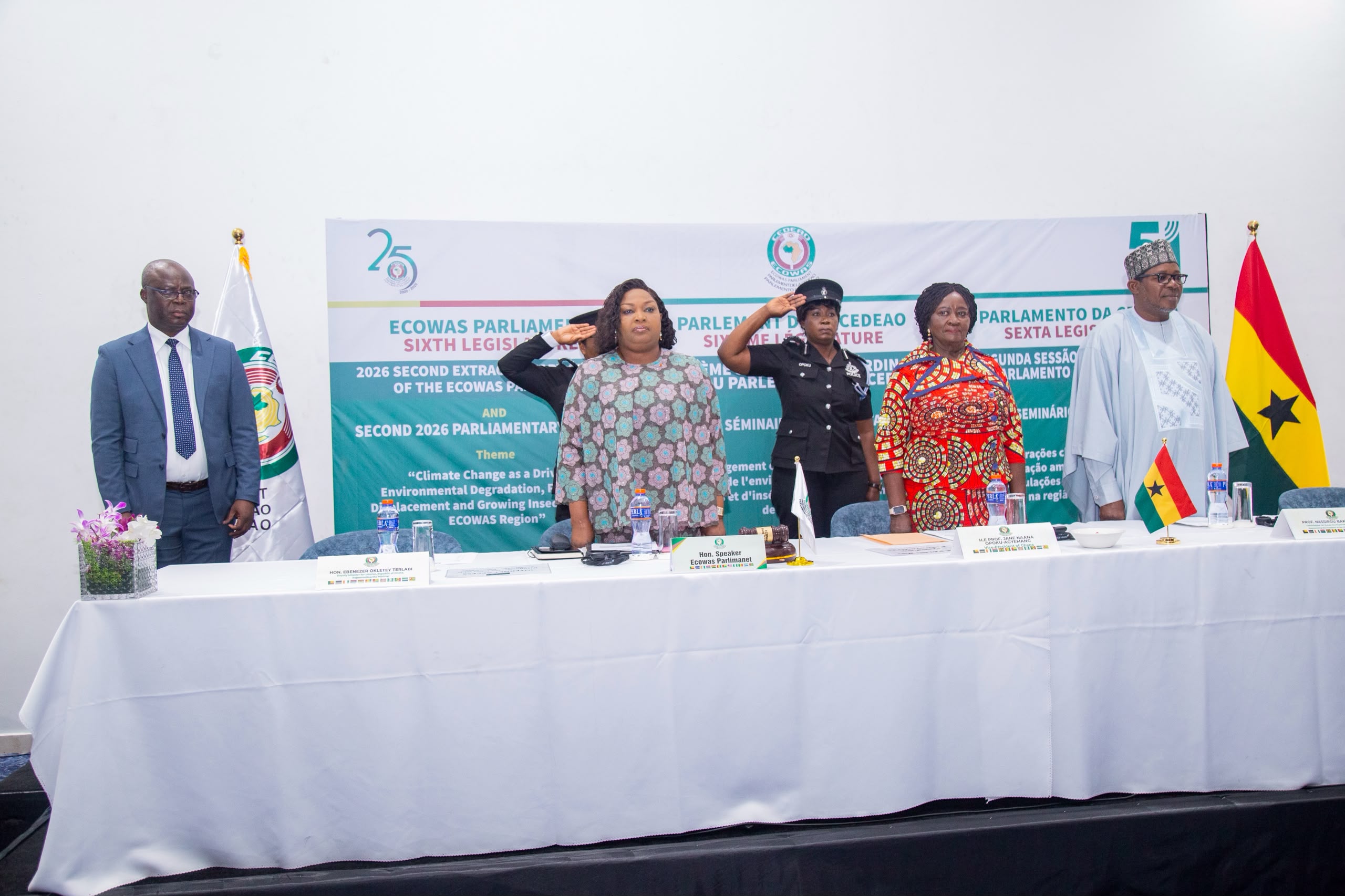
The Second 2026 Parliamentary Seminar and Second Extraordinary Session of the ECOWAS Parliament, holding in Accra, is providing a platform for parliamentarians to examine how the region can move beyond climate commitments and develop practical responses capable of protecting vulnerable populations and strengthening regional resilience.
The discussions, which commenced on September 21, are continuing with particular attention to the human consequences of environmental change, including declining agricultural productivity, flooding, drought, desertification, coastal erosion, food insecurity and the displacement of populations.
At the joint opening of the seminar and Extraordinary Session on September 22, Ghana’s Vice President, Professor Jane Naana Opoku Agyemang, called for stronger regional cooperation in addressing the interconnected challenges of climate change, insecurity and displacement.
She said the challenges confronting West Africa required responses that combine security, development and climate resilience, while urging ECOWAS Member States to strengthen early warning systems, support vulnerable communities and invest in resilient livelihoods.
The Speaker of the ECOWAS Parliament, Rt. Hon. Hadja Mémounatou Ibrahima, had earlier urged parliamentarians to look beyond climate statistics and focus on the realities confronting communities across the region.
According to her, the effects of climate disruption are already visible in declining agricultural output, retreating coastlines, flooded communities, loss of livelihoods and the forced relocation of families.
Her position captures the central concern emerging from the Accra discussions: climate change is no longer exclusively an environmental issue. It is increasingly intertwined with humanitarian conditions, migration, development, peace and security.
 A region under mounting pressure
 A region under mounting pressure
For millions of people across West Africa, agriculture, fishing and pastoralism remain central to livelihoods. But changing rainfall patterns, prolonged droughts, flooding, desertification and degradation of natural resources are placing increasing pressure on these traditional sources of income.
The ECOWAS background paper prepared for the seminar notes that the region’s dependence on climate sensitive sectors, combined with limited adaptive capacity, makes communities particularly vulnerable to environmental changes.
The consequences extend beyond lost income.
When farmland becomes less productive, grazing routes are disrupted or water sources become scarce, people are often compelled to move in search of safer environments and alternative livelihoods.
This movement can place additional pressure on communities receiving displaced populations, particularly where access to land, water and pasture is already limited.
In such circumstances, climate change can become an amplifier of existing social and economic tensions.
The Lake Chad warning
The Lake Chad region provides one of the clearest examples of how environmental, humanitarian and security challenges can converge.
The basin supports millions of people across Nigeria, Niger, Chad and Cameroon, but the area has also experienced the combined effects of climate pressure, poverty, food insecurity, environmental degradation, population displacement and insecurity.
The ECOWAS background paper puts the number of displaced people in the Lake Chad region at more than 3.53 million, with about 8.2 million people requiring humanitarian assistance.
The crisis also demonstrates the limitations of isolated national responses.
As insecurity and environmental pressures cross borders, people move from one country to another, placing additional demands on host communities, humanitarian systems and public infrastructure.
Borno State in Nigeria, Cameroon’s Far North, Niger’s Diffa region and Chad’s Lac Province remain among the areas experiencing the consequences of this interconnected crisis.
For the ECOWAS Parliament, the lesson is clear: a regional problem requires regional cooperation.
The security dimension
Climate change is also altering the security landscape.
The parliamentary background paper describes climate change as a threat multiplier because it can deepen existing vulnerabilities by disrupting livelihoods, increasing competition over resources and encouraging migration and displacement.
The effects are particularly significant for young people.
Where farming, fishing and other traditional economic activities become less reliable, young people may face shrinking opportunities for employment and economic advancement.
The Accra discussions have therefore linked climate resilience with youth empowerment, recognising that strengthening livelihoods and expanding economic opportunities can also contribute to preventing vulnerability to criminal and extremist recruitment.
Ghana’s Vice President similarly stressed the importance of investing in education, skills and opportunities for young people as part of a broader approach to peace and security.
The challenge of climate finance
One of the most significant issues before the parliamentarians is how to finance the response.
The ECOWAS background paper estimates that Member States require about US$294 billion to implement their Nationally Determined Contributions.
Yet access to international climate finance remains constrained by complex procedures, accreditation requirements, limited project preparation capacity and institutional challenges.
For a region facing extensive climate related vulnerabilities, the gap between the resources required and those available remains a major concern.
The discussions in Accra are therefore examining not only how climate policies should be designed, but how they can be adequately financed, monitored and translated into programmes that reach communities most exposed to environmental and economic shocks.
Communities are already responding
While the challenges are considerable, the seminar is also highlighting examples of adaptation and resilience emerging across West Africa.
Ghana and Côte d’Ivoire have developed transboundary cooperation around coastal management, while Togo and Benin have collaborated on measures to protect vulnerable sections of their shared coastline.
In Ghana’s Keta Ada coastal area, community participation, mangrove restoration, traditional knowledge and early warning systems are being used to strengthen resilience.
In Senegal, community led coastal protection initiatives are helping to protect livelihoods, while a project involving shea collectors in Burkina Faso and Togo is combining climate adaptation with women’s economic empowerment.
These initiatives demonstrate that local communities are not merely victims of climate change. They are also developing practical responses based on their knowledge of their environment.

From commitments to action
As the ECOWAS Parliament continues its deliberations in Accra, attention is increasingly shifting towards what should happen after the discussions.
The parliamentary background paper proposes stronger legislation on climate action, improved oversight of climate policies, closer scrutiny of climate budgets, increased access to international climate finance and greater support for climate resilient livelihoods.
It also calls for the integration of climate security into national policies, stronger regional cooperation and improved early warning systems.
The recommendations place a significant responsibility on parliamentarians to ensure that climate policies are supported by legislation, funding, monitoring and accountability.
A test of regional cooperation
The significance of the Accra meeting extends beyond the conference rooms where parliamentarians and experts are exchanging views.
Across West Africa, the consequences of climate change are increasingly visible in communities facing drought, flooding, land degradation, coastal erosion, displacement and declining livelihoods.
The challenge before ECOWAS is how to ensure that these pressures do not continue to deepen existing humanitarian and security vulnerabilities.
The ongoing parliamentary engagement in Accra therefore represents an important opportunity to examine climate change not simply as a question of the environment, but as a regional development and human security issue requiring coordinated action.
For a region where people, resources, economies and security are deeply interconnected, the response to climate change may ultimately depend on the ability of ECOWAS Member States to act collectively before environmental pressures become irreversible crises.
And as the parliamentarians continue their work in Accra, the central question remains how to turn climate knowledge, regional commitments and parliamentary recommendations into practical measures capable of protecting the people and communities most exposed to a changing environment.