Jane Salihu
The Joint Admissions and Matriculation Board (JAMB) has reiterated its resolve to promote inclusive higher education by leveraging Artificial Intelligence (AI), innovation and strategic partnerships to improve access for persons with disabilities.
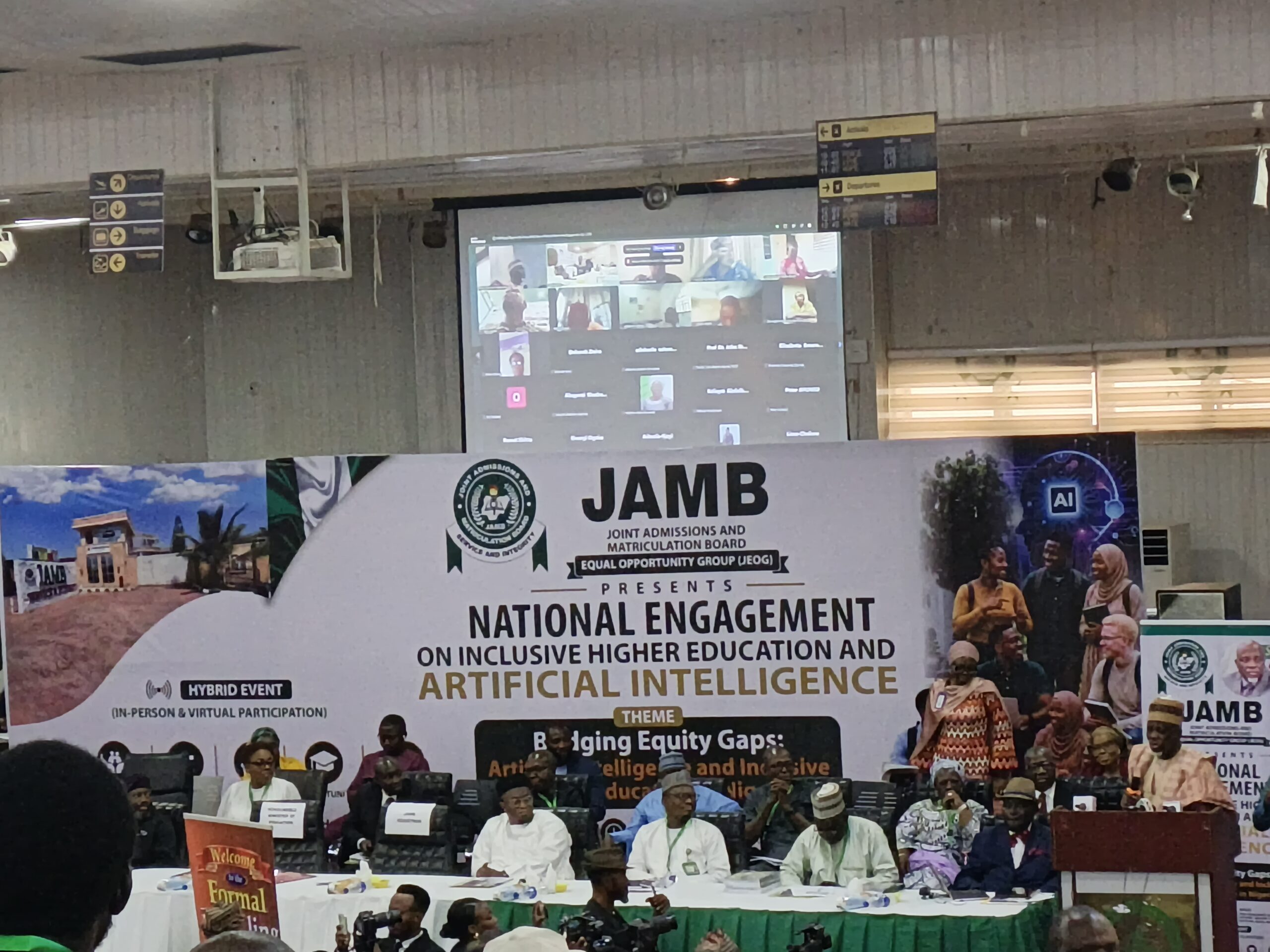
The commitment formed the focus of discussions at the National Stakeholders’ Engagement on Inclusive Higher Education and Artificial Intelligence, organised on Wednesday by the JAMB Equal Opportunity Group (JEOG) at the National Universities Commission (NUC) in Abuja.
Speaking at the event, the Registrar of JAMB, Prof. Is-haq Oloyede, said the Board remains determined to ensure that disability is never a barrier to accessing quality higher education in Nigeria.
He explained that the JAMB Equal Opportunity Group was established about 10 years ago as one of several specialised committees created by the Board to strengthen its operations and provide dedicated support for candidates with special needs.
According to him, the anniversary presents an opportunity to review the achievements recorded over the last decade, identify existing gaps and chart a new direction for advancing inclusive higher education.
Ten years ago, we decided to look for people who are competent beyond doubt to handle each of our major tasks. This engagement is to review what we have done, identify what more can be done and ensure that we move to the next stage,” Oloyede said.
He noted that Artificial Intelligence offers a new opportunity to improve access, learning and inclusion for persons with disabilities, adding that JAMB would continue to work with relevant stakeholders to ensure technology is deployed to promote equal opportunities in higher education.
Also speaking, the Executive Secretary of the National Universities Commission (NUC), Prof. Abdullahi Ribadu, represented by the Director of Research, Innovation and Information Technology, Dr. Lawal Faruk, said universities must embrace AI while ensuring that no learner is left behind.
He said the Commission had embedded inclusion in its ongoing reforms through the Core Curriculum and Minimum Academic Standards (CCMAS), while promoting digital literacy, innovation and emerging technologies across Nigerian universities.
Speaking with journalists shortly after the event, Chairman of the JAMB Equal Opportunity Group (JEOG), Prof. Peter Okebukola, said the stakeholder engagement was organised to review a decade of JEOG’s operations and explore how Artificial Intelligence could further advance inclusive higher education in Nigeria.
He disclosed that 4,216 candidates with disabilities, including persons with visual impairment, autism, Down syndrome and albinism, have benefitted from the initiative since its establishment.
According to him, the candidates sat the same Unified Tertiary Matriculation Examination (UTME) as every other applicant without any reduction in academic standards, with about 53 per cent securing admission annually into universities, polytechnics and colleges of education.
Okebukola added that AI should be intentionally designed to eliminate barriers faced by persons with disabilities rather than inadvertently excluding them from educational opportunities.
A major highlight of the event was the unveiling of “A Peep into the Future of Higher Education in Nigeria,” a book edited by Okebukola in honour of the outgoing JAMB Registrar, Prof. Is-haq Oloyede.
He explained that the publication contains contributions from 44 scholars selected from nearly 700 submissions, offering practical recommendations on repositioning Nigeria’s higher education system over the next decade.
Another book, “Early Start, Great Finish: Survival and Success Manual for Underage Nigerian University Students,” authored by Okebukola, was also unveiled. He said the manual was developed after extensive consultations with education experts and underage students to guide parents, lecturers and university administrators on supporting exceptionally young undergraduates.
The event also featured the presentation of awards to tertiary institutions promoting disability inclusion, recognition of outstanding candidates with disabilities in the Unified Tertiary Matriculation Examination (UTME), and honours for individuals who have made significant contributions to inclusive education in Nigeria