Jame Salihu
The Federal Government is strengthening Nigeria’s education system to produce graduates with practical digital skills, entrepreneurial abilities and problem-solving capacity needed to compete in the evolving global labour market.
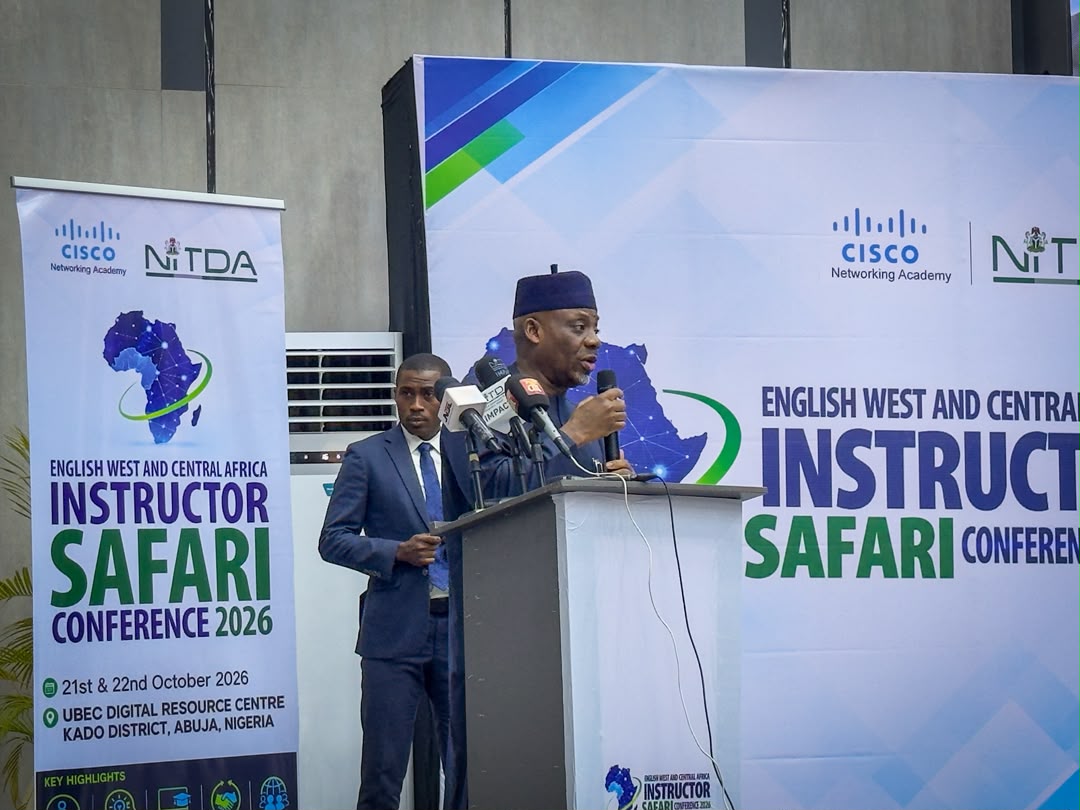
The Minister of Education, Dr. Maruf Tunji Alausa, stated this while delivering the keynote address at the Cisco Networking Academy Instructor Safari Conference for English West and Central Africa, themed “Navigating the Future of Skills Development for the Nigerian Economy.”
Alausa said the government was moving away from an education system focused largely on academic learning to one that prepares students for employment, innovation and enterprise creation in a technology-driven economy.
He noted that ongoing curriculum reforms were integrating digital technology from the primary school level to build a strong foundation for advanced digital competencies.
“Across every sector, digital technology is changing how we learn, work, communicate and create value. Our responsibility is to ensure that Nigerian young people have the opportunity to acquire these skills and apply them productively,” he said.
The minister identified software development, networking, cybersecurity, data analytics, cloud computing and artificial intelligence as critical areas of competence for young Nigerians seeking to take advantage of emerging employment opportunities.
He, however, stressed that technical knowledge alone was insufficient, noting that young people must also develop critical thinking, communication, teamwork and practical problem-solving skills.
Alausa urged digital training institutions to measure their success by the ability of learners to develop practical solutions, create useful products, improve services and establish sustainable businesses rather than relying solely on examination results.
He called for stronger collaboration between educational institutions, employers and industry stakeholders to bridge the gap between training and employment.
According to him, training programmes should incorporate practical projects, mentorship, internships and recognised certifications to ensure that learners acquire skills relevant to workplace demands.
The minister added that portfolios demonstrating students’ practical achievements would improve their chances of securing employment, establishing businesses and pursuing further learning.
He also emphasised the need to make digital education more inclusive by expanding access to affordable internet connectivity, digital devices and accessible learning resources, particularly for girls, persons with disabilities, rural learners and young people from low-income backgrounds.
Alausa said the Federal Ministry of Education’s six priority areas, including Science, Technology, Engineering, Mathematics and Medical Sciences (STEMM), Technical and Vocational Education and Training (TVET), girl-child education, reduction of out-of-school children, data and digitalisation, and quality assurance, were designed to develop a workforce capable of responding to changing economic needs.
He explained that digital competencies cut across the priority areas by strengthening practical learning, expanding educational access and supporting evidence-based planning.
In a related address, the Director-General of the National Information Technology Development Agency (NITDA), Kashifu Inuwa Abdullahi, said digital skills could transform career opportunities and prepare Nigerians for changing workplace demands.
Drawing from his experience as a Cisco Networking Academy alumnus, Abdullahi urged instructors to prioritise critical thinking, complex problem-solving and lifelong learning rather than focusing exclusively on examination success.
He also highlighted collaboration between NITDA and the Federal Ministry of Education to integrate digital literacy into school curricula and tertiary education.
The minister assured Nigerians that the Federal Government would sustain education reforms under President Bola Ahmed Tinubu’s Renewed Hope Agenda, deepen partnerships with industry and development partners, and expand access to quality digital skills training.
He formally declared the conference open, expressing confidence that sustained investment in digital education would produce competent professionals, innovative entrepreneurs and a workforce capable of contributing to national development.