Jane Salihu
The Nigeria Police Force is seeking to strengthen its capacity to tackle insurgency, kidnapping and other security threats through a proposed international training programme targeting up to 5,000 police personnel under a cooperation framework involving Nigeria, the United States and Italy.
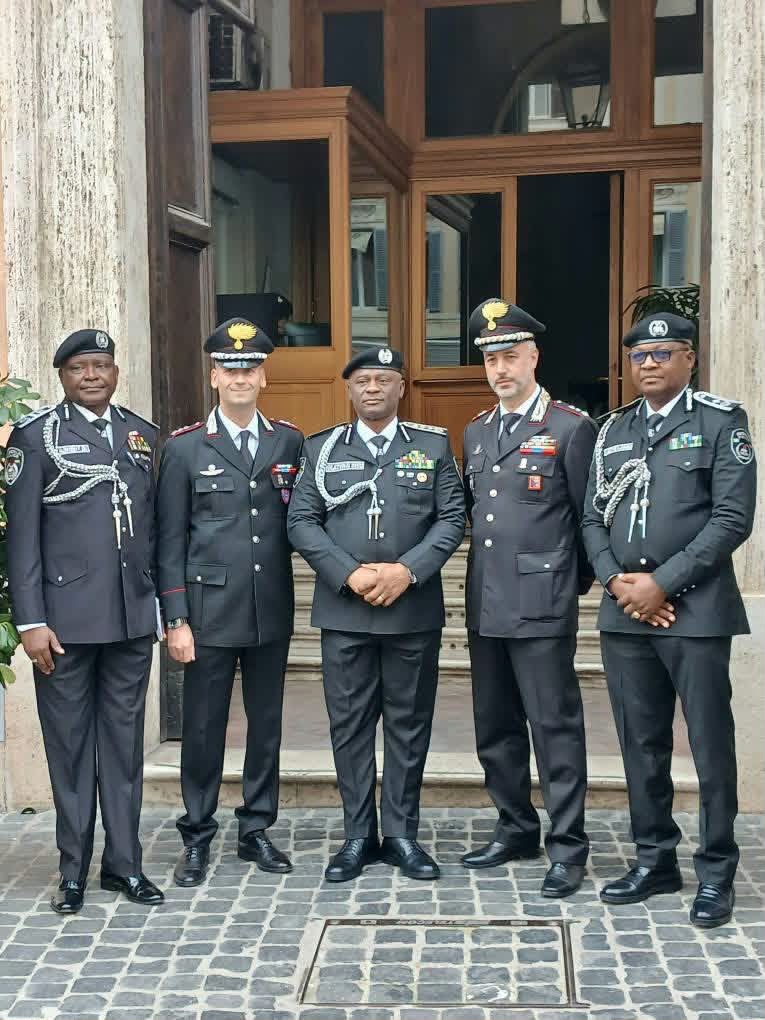
The Inspector-General of Police, IGP Olatunji Rilwan Disu, disclosed this during his working visit to Italy, where he held discussions with Italian law enforcement authorities on specialised training, technology transfer and institutional support to improve policing operations in Nigeria.
The proposed programme will prioritise counter-insurgency operations, particularly in rural and forested communities, while equipping officers with specialised skills to address emerging security challenges.
The training is expected to cover tactical operations, intelligence-led patrols, explosives detection, digital and scientific forensics, cybercrime investigation, financial investigations, asset tracing and anti-extortion techniques.
Beyond the Police Mobile Force, the initiative is also expected to benefit other specialised units, including explosive ordnance disposal and forensic teams.
During a meeting with the Commander General of the Italian Carabinieri, Lieutenant-General Salvatore Luongo, Disu explored areas of technical assistance, professional training and institutional cooperation between both police institutions.
At the Carabinieri Centre of Excellence for Stability Police Units (CoESPU) in Vicenza, the Nigerian delegation assessed available training facilities and discussed how Italy’s expertise could be adapted to address Nigeria’s peculiar security challenges.
Among the proposals are command courses for 40 senior police officers, leadership development programmes for 100 junior commanders and the deployment of a mobile assistance team to support Police Mobile Force training schools in Gwoza and Ila-Orangun.
The discussions also covered the development of a national stability policing doctrine and standard operating procedures to guide police operations, promote professionalism and strengthen civilian protection, particularly in communities recovering from conflict.
Other areas identified for possible collaboration include canine operations, forensic science and mounted policing, with discussions extending to horse breeding and local capacity development for public order management.
To translate the proposals into practical arrangements, the IGP called for a Memorandum of Understanding covering specialised training, technology transfer and operational doctrine. He also invited a Carabinieri assessment team to Abuja to evaluate the Force’s needs and identify priority areas for implementation.
The proposed partnership forms part of efforts by the Nigeria Police Force to draw on international expertise in strengthening its operational capabilities, improving investigations and enhancing its response to evolving security threats.
Disu reiterated the Force’s resolve to sustain international engagements that would support the protection of lives and property and contribute to building a more professional and responsive police institution.