Jane Salihu
The Universal Basic Education Commission (UBEC) is set to overhaul the way basic education interventions are planned and funded, with states expected to assess and address the full range of needs in individual schools under its new 10-year roadmap.
The commission said implementation of the Universal Basic Education Roadmap 2026–2035 will commence in the first week of October, marking a shift away from isolated projects towards a comprehensive “whole school approach”.
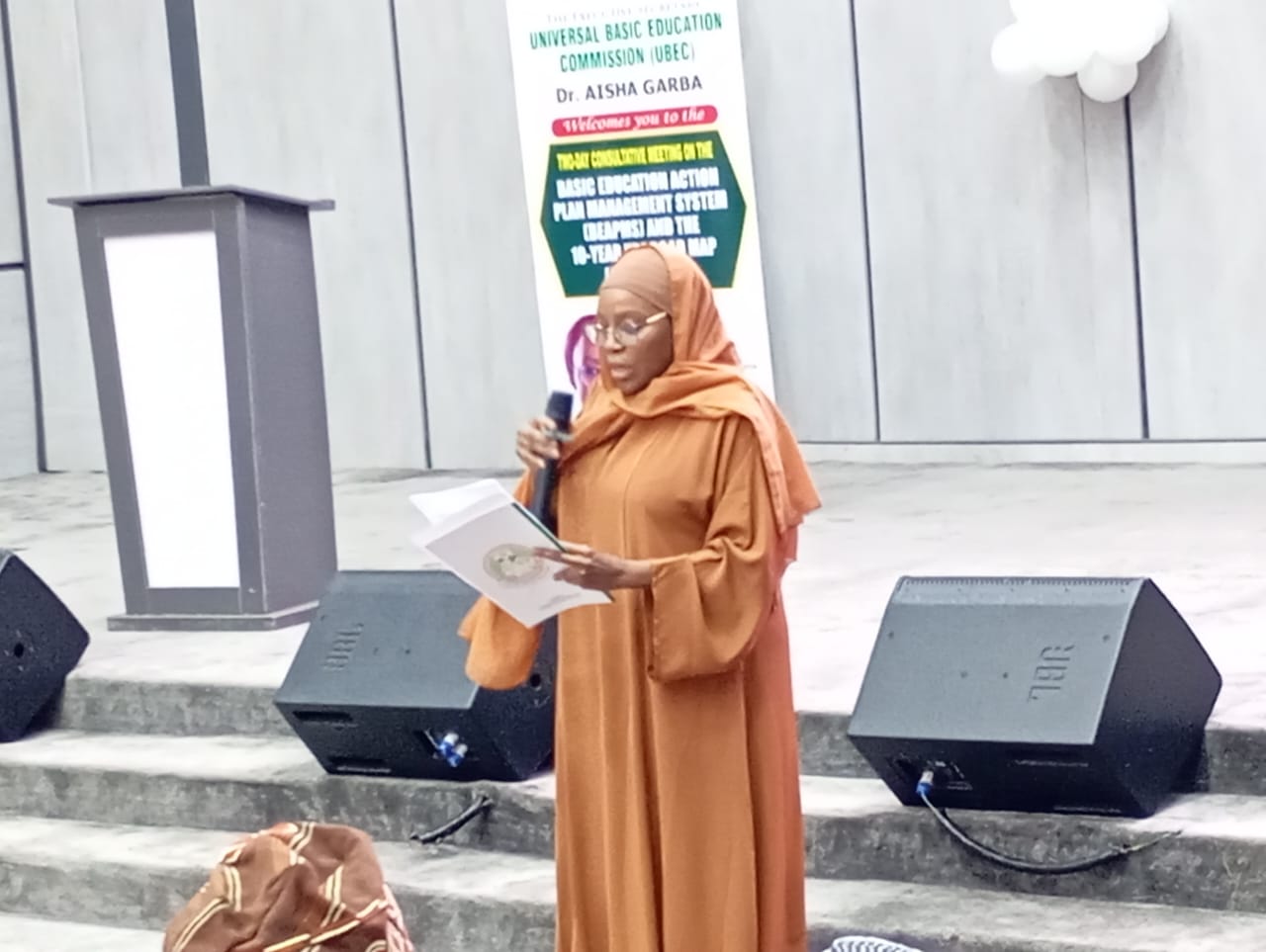
UBEC Executive Secretary, Dr. Aisha Garba, disclosed this in Abuja on Monday at a two-day consultative workshop involving chairmen of the 36 State Universal Basic Education Boards (SUBEBs) and UBEC directors.
Garba said the new approach was designed to prevent situations where schools receive classrooms or furniture while lacking other basic facilities needed for effective teaching and learning.
She explained that under the new framework, states would have to identify the complete needs of a school before UBEC approves its intervention plan.
“For any state to do renovation, you have to do a whole school approach. A whole school approach means, you take a school and you look at all the gaps,” she said.
According to her, interventions could cover fencing, toilets, furniture, computers, renovation and other facilities, depending on the needs identified in each school.
She said the commission was also revising its matching grant formula to give states greater flexibility to direct UBEC funds towards their most pressing basic education needs.
Garba explained that the previous funding formula placed considerable emphasis on new infrastructure, even in situations where states needed to maintain or upgrade existing schools.
“The new formula allows each state to look at their own needs,” she said, adding that states could prioritise furniture, renovation, fencing, computers and other requirements based on their circumstances.
The UBEC boss also unveiled the Basic Education Action Plan Management System (BEAPMS), a digital platform designed to strengthen planning, transparency and monitoring of basic education interventions.
She said the platform would eventually allow parents and community members to monitor projects in their schools, including information on funding accessed by states and the projects being executed.
“This will also allow us to bring in the community to be part of the monitoring of the projects that we do on the ground,” Garba said.
She added that publishing details of funds accessed and projects implemented would enable communities to demand accountability from stakeholders responsible for delivering the interventions.
The commission said BEAPMS had been in development for more than a month, with SUBEB chairmen already onboarded ahead of the October rollout.
Speaking on the roadmap, the Dean of SUBEB Chairmen, Prof. Shehu Adaramaja, said the consultation would provide a common framework for states to improve access, quality and management of basic education over the next decade.
Adaramaja, who is also the Kwara State SUBEB Chairman, said directors of research and statistics would participate directly in developing the framework that would guide individual states in preparing their basic education action plans.
He noted that UBEC’s intervention mandate had expanded beyond physical infrastructure to include other areas required to strengthen basic education delivery.
Earlier, UBEC Director of Physical Planning, Arc. Nura Ibrahim, said the workshop would enable stakeholders to review and validate the proposed 10-year roadmap while contributing technical knowledge and practical experience from the states.