By admin
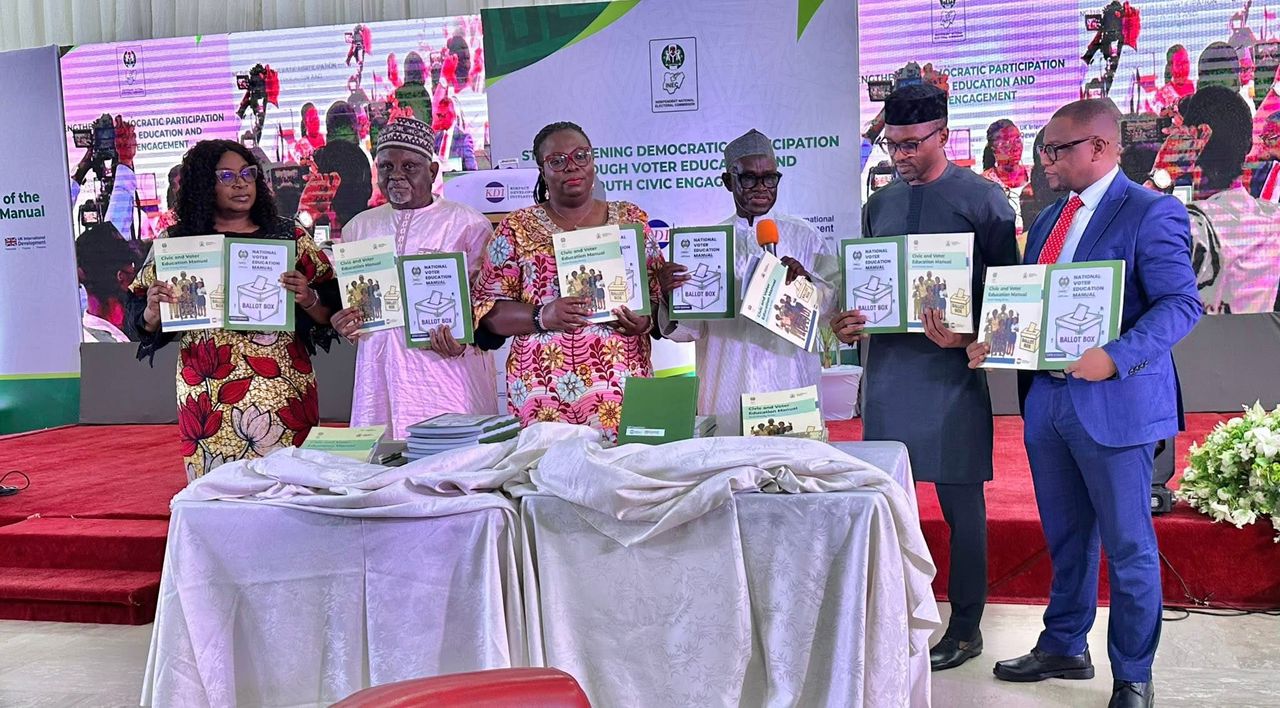
The Independent National Electoral Commission (INEC), in collaboration with national and international partners, has launched an updated National Voter Education Manual and a youth-focused Civic and Voter Education Manual as part of efforts to boost citizen participation ahead of the 2027 general elections.
The unveiling, held in Abuja, brought together stakeholders from government agencies, civil society organisations, development partners and youth groups to promote a more informed and active electorate.
Speaking at the event, Chairman of INEC’s Information and Voter Education Committee, Mohammed Haruna, expressed concern over the steady decline in voter turnout since Nigeria’s return to democracy in 1999.
According to him, voter participation has dropped from over 60 percent in 2003 to below 30 percent in recent elections. He noted that while many Nigerians value their right to vote, a significant number lack the knowledge or motivation to exercise that right effectively.
Haruna explained that the manuals were developed in partnership with the Kimpact Development Initiative (KDI) to strengthen civic awareness and encourage greater participation in the electoral process.
Delivering the keynote address on behalf of INEC Chairman, Joash Amupitan, a National Commissioner, Malam Mohammed Haruna, warned that voter apathy remains one of the greatest threats to Nigeria’s democracy.
He cited recent electoral data indicating a growing participation gap in which a small minority determines leadership for the larger population.
The Commission noted that the Electoral Act 2026 introduces stronger transparency measures through improved legal frameworks and electronic processes, but stressed that legislation alone cannot address public disengagement.
“An indifferent electorate is a democracy in retreat,” the keynote message stated, urging sustained civic education to rebuild public trust and participation in elections.
In his remarks, Team Leader of KDI, Bukola Idowu, described the initiative as more than a document launch, calling it a strategic intervention aimed at strengthening Nigeria’s democratic foundation.
He said the revised manual reflects new electoral laws, emerging technologies and the evolving realities of political participation, while the youth-focused version is designed to empower young Nigerians as voters, civic educators and agents of democratic change.
Representing the Director-General of the National Orientation Agency (NOA), Oluwakemi Afolayan noted that democracy thrives not only through elections but also through civic values and informed citizenship.
She described the initiative as timely, adding that integrating the civic education manual into the National Youth Service Corps (NYSC) framework would strengthen grassroots engagement and foster long-term civic awareness.
“An informed electorate is the strongest defence against voter apathy, misinformation and electoral violence,” she said.
Also speaking, Matthew Ayibakuro of the UK Foreign, Commonwealth and Development Office emphasised the role of continuous voter education in ensuring credible and inclusive elections.
He noted that elections are not a one-day event but the outcome of sustained civic awareness and public trust.
Providing an overview of the manuals, INEC’s Director of Voter Education and Publicity, Victoria Eta-Messi, said the updated edition has been comprehensively revised to align with the provisions of the Electoral Act 2026.
She highlighted key updates including new regulations on party primaries, campaign finance rules, electoral offences and the continued deployment of technologies such as the Bimodal Voter Accreditation System (BVAS).
The revised manual is now structured into 11 modules and incorporates global best practices as well as expanded digital engagement strategies to reach Nigeria’s growing population of tech-savvy voters.
A major highlight of the initiative is the integration of the civic manual into the NYSC Community Development Service programme, positioning corps members as frontline civic educators across communities nationwide.
Stakeholders at the event said the peer-to-peer approach will help spread democratic values through schools, markets, religious centres and local communities, ultimately strengthening public participation in Nigeriaa