Jane Salihu
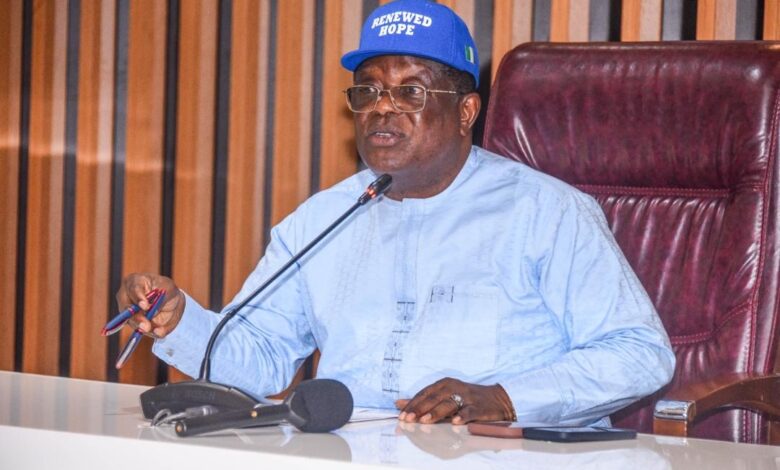
Minister of Works, Engr. David Umahi, has urged political leaders and stakeholders in the South-East who support President Bola Tinubu to openly express their position and educate the people on the administration’s interventions in the region.
Umahi made the call on Tuesday in Abuja while receiving Senior Special Assistants to the President on Community Engagement and Students Affairs and the leadership of the National Association of Nigerian Students (NANS), who presented findings from their nationwide inspection of federal road projects.
The minister said South-East leaders should not be afraid to tell their people the truth about their political choices, particularly with regard to infrastructure projects and other interventions by the Federal Government.
He commended South-East governors who, according to him, had openly expressed support for President Tinubu, urging other stakeholders to engage their communities on the impact of the administration’s projects.
Umahi also commended NANS for independently undertaking the nationwide Federal Roads Project Tour, saying the students’ decision to inspect the projects without being invited or sponsored by the government demonstrated responsible leadership.
He urged the students and other stakeholders to continue informing Nigerians about the impact of federal infrastructure projects, particularly road construction and bridge development.
The minister said improved road infrastructure was not only important for transportation but could also contribute to addressing insecurity by making isolated and inaccessible routes less attractive to criminal elements.
Presenting the report of the North-West leg of the tour, NANS representative, Comr. Akinteye Babatunde Afeez, said the exercise was designed to enable students independently inspect completed and ongoing federal road projects and assess their impact on education, mobility and safety.
Afeez said NANS had previously relied on reports from the Ministry of Works but decided to conduct physical inspections to verify project progress, assess their relevance to students and communities, document observations and provide constructive feedback.
“We don’t just want to stay back in our campuses; we took it upon ourselves to go to the field. We travelled the roads. We inspected the projects,” Afeez said.
The North-West leg covered Kano, Jigawa, Kaduna and Sokoto States, where the delegation inspected federal road projects including the Kano-Kwanar Danja-Hadejia Road, Section II, Kano-Tsalle, Kano Northern Bypass and Kano-Maiduguri Road.
Afeez said the exercise also focused on major roads serving campuses and student communities, the impact of completed projects on mobility and safety, and areas requiring further attention.
Representatives from the North-West, North-East, North-Central, South-West and South-East also presented observations from their respective regions, highlighting improved road connectivity, bridge construction, concrete pavement, solar-powered streetlights and security features on some projects.
The South-East delegation cited the rehabilitation of the First Niger Bridge, connecting roads around the Second Niger Bridge and other federal projects, saying the improved infrastructure had enhanced movement between communities.
The students called for sustained community engagement and transparency in the execution and monitoring of federal road projects.